
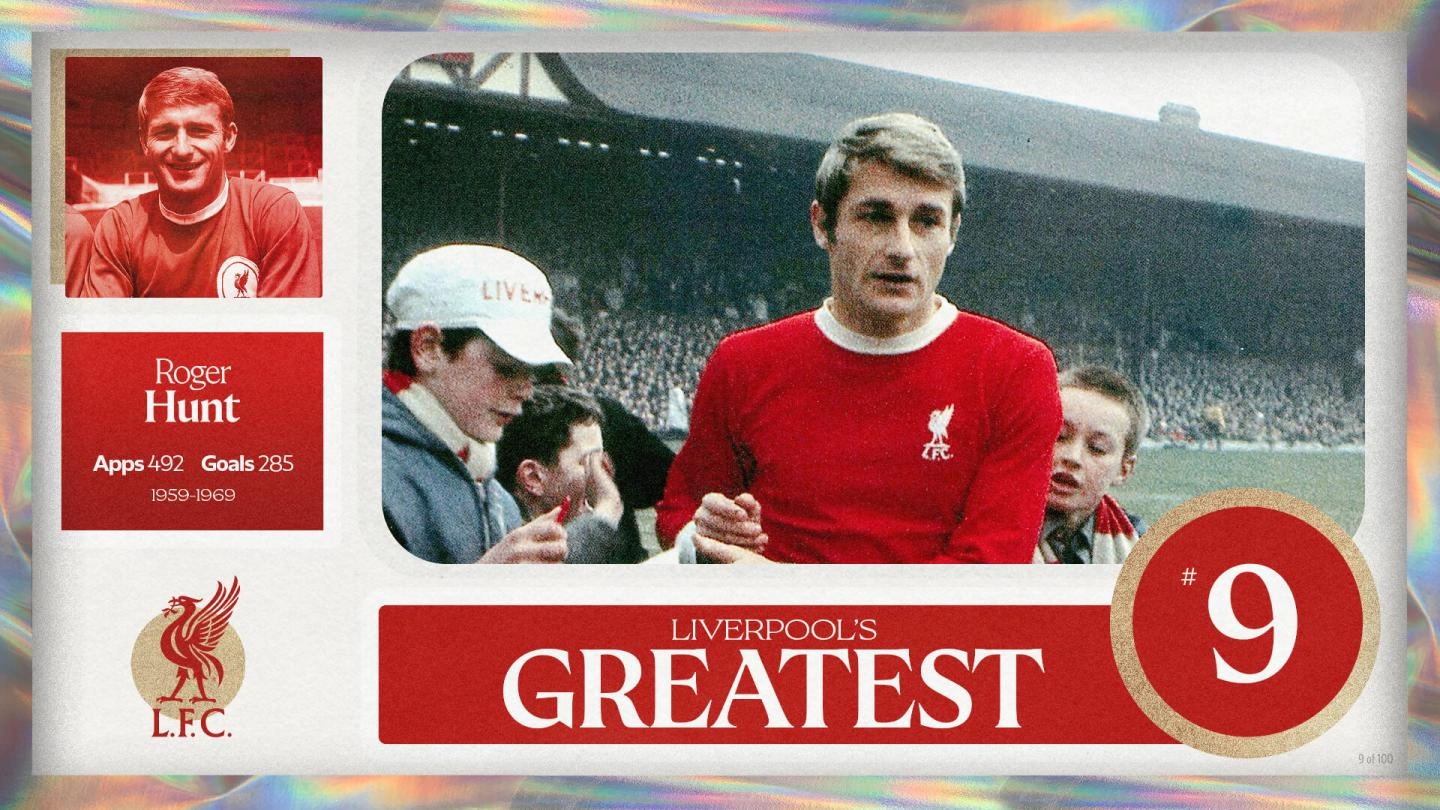
Before Mohamed Salah. Before Ian Rush. Before Robbie Fowler. Before any of the brilliant goalscorers who have lit up Anfield across the decades, there was Roger Hunt. A man so beloved by the Liverpool supporters who watched him week in and week out that they bestowed upon him an honorary knighthood, the most affectionate and enduring tribute the Kop has ever paid to one of its own. They called him Sir Roger. They built flags in his honour that still flutter above the Kop to this day, more than five decades after he played his final game in red. And as Liverpool’s Greatest list reaches its top ten, the striker who helped Bill Shankly turn a Second Division club into the dominant force in English football takes his rightful place at number nine.
From Stockton Heath to Shankly’s Revolution
The Roger Hunt story does not begin with fanfare or astronomical transfer fees. It begins in July 1958, when Liverpool manager Phil Taylor signed a raw, hungry young forward from the amateur club Stockton Heath. He was a young man from Glazebury in Lancashire, and the step into professional football at a club that had spent years bouncing between the top two divisions was significant. His debut came on 9 September 1959, a Second Division home fixture against Scunthorpe United, and he marked it with a goal in a 2-0 victory. It was the first of 285 goals that would follow over the next decade, and the beginning of one of the most extraordinary careers this club has ever witnessed.
When Bill Shankly arrived at Anfield later that year and embarked on his famous clear-out, dispensing with 24 players in a ruthless but visionary restructuring of the squad, Hunt was among the small number retained. It was perhaps the single most important decision Shankly made in those early months. He saw in Hunt not just a goalscorer but the embodiment of everything he wanted his Liverpool team to represent: relentless work ethic, total commitment, and a hunger to succeed that never needed to be manufactured because it came from deep within the man himself.
“I made up my mind that if I didn’t succeed at Anfield then it wouldn’t be for the lack of determination,” Hunt said. “From the first day I threw myself into training, ran and tackled for everything, and practised my ball skills at every opportunity.” Those words could have been written as the mission statement of Shankly’s entire Liverpool project. Together, the manager and his striker were about to do something remarkable.
41 Goals in 41 Games: The Season That Changed Everything
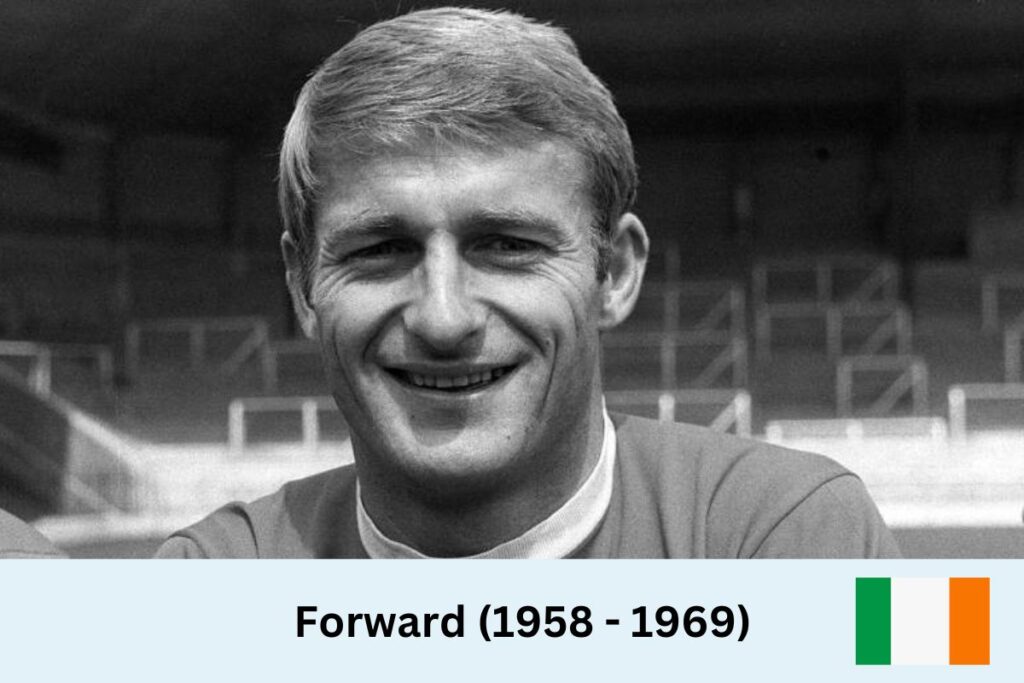
Hunt‘s early seasons at the club produced 42 goals across his first two campaigns, a more than respectable return that established him as a player of genuine quality. But it was the arrival of Ian St John from Motherwell in May 1961 that transformed Hunt from a very good striker into an unstoppable force. The partnership that Shankly built around these two players became one of the most celebrated attacking combinations in the history of English football, two forwards whose movement, chemistry and goals-per-game rate were unlike anything the division had seen.
In the 1961-62 campaign, Roger Hunt produced one of the most astonishing individual seasons in the history of the Football League. He scored 41 goals in 41 league appearances. Forty-one goals in forty-one games. An average of precisely one goal per match, including five hat-tricks, across a full league season of top-level professional football. Liverpool won the Second Division title and were promoted to the First Division, and Hunt was the engine that drove the entire campaign forward. It remains one of the most extraordinary goalscoring achievements any player has ever produced for this club, and it set the tone for everything that followed.
The Golden Era: Titles, the FA Cup and a World Cup Winner
The step up to the First Division presented no difficulty whatsoever for Hunt, who proved himself as ruthlessly effective against the best defenders in the country as he had been against those in the second tier. He became Liverpool’s top scorer for eight consecutive seasons, reaching 30 goals in five of those campaigns, an achievement of sustained excellence that only the very greatest strikers are capable of sustaining over such a long period.
The trophies followed. Liverpool won the First Division title in 1963-64, with Hunt contributing 31 goals in 41 league appearances, a staggering return that was central to the club’s first top-flight championship in seventeen years. Two seasons later, in 1965-66, they won it again, with Hunt netting another 30 league goals. Between those two triumphs came the moment of perhaps greatest historical significance in Liverpool’s pre-European Cup history: the 1965 FA Cup final at Wembley.
Liverpool had never won the FA Cup before that afternoon at Wembley on 1 May 1965, and after a goalless first 90 minutes against Leeds United, the tension inside the stadium was almost unbearable. It was Roger Hunt who broke the deadlock, scoring the opening goal in extra time with the composure and clinical precision that had come to define his entire Liverpool career. Ian St John added the second minutes later, and Liverpool’s 2-1 victory over Leeds delivered the club its first ever FA Cup. Hunt had opened the scoring in one of the most significant matches in the club’s entire history. The Kop never forgot it.
Hunt also carried his Liverpool form onto the international stage with England, forming part of the squad that won the 1966 FIFA World Cup at Wembley under Alf Ramsey. He played in all six of England’s matches and scored three goals across the tournament, and was a valued member of a side in which Geoffrey Hurst’s hat-trick in the final against West Germany has overshadowed the collective contribution of many equally important performers. Hunt’s role in that World Cup triumph gave the Liverpool faithful an additional source of enormous pride, the knowledge that the man who had helped build their club was also a world champion.
The Records That Endure
By November 1967, Hunt had surpassed Gordon Hodgson’s previous Liverpool record of 241 goals to become the club’s all-time leading scorer, doing so in an Inter-Cities Fairs Cup tie against TSV 1860 Munich. His final tally of 285 goals across 492 appearances is a figure that has only ever been beaten by Ian Rush, who required 660 appearances to surpass it. Rush is rightly celebrated as one of the greatest goalscorers in Liverpool history, but it says everything about Hunt’s achievement that it took the club’s most prolific finisher nearly 170 more appearances to overtake his record.
Even more remarkably, Hunt’s record of 244 league goals for Liverpool has never been beaten. Not by Rush, not by Fowler, not by Salah in his magnificent nine-year stay. Every Liverpool striker who has come since has fallen short of that league total. It is a record that has stood for more than half a century and remains one of the most enduring individual achievements in English football history. A flag honouring Hunt continues to fly on the Kop at Anfield, a living, permanent testament to what he meant and continues to mean to the club and its supporters.
He also holds another, perhaps lesser-known distinction that links him permanently to football history. On the opening day of the 1964-65 season against Arsenal, Roger Hunt scored the first ever goal to be broadcast on BBC’s Match of the Day. The programme that has become the most famous football show in the world began its life with a Hunt goal. Of course it did.
A Farewell and a Legacy That Never Dimmed
Hunt departed Liverpool in December 1969, sold by Shankly to Bolton Wanderers as the great manager began dismantling his first outstanding team to build a second. His final appearance came as a substitute at home to Manchester United, and when he walked off that pitch for the last time, he left behind 285 goals, 12 hat-tricks, four major trophies, and an unbreakable bond with every Liverpool supporter who had watched him play.
Three years after leaving, his testimonial match was held at Anfield. A reported capacity crowd of more than 55,000 descended on the ground in terrible weather, rain lashing down across a midweek evening, to pay tribute to a man who had been retired for some time. His daughter Julie later recalled his reaction. “When Dad retired from football in 1972, he was worried that the fans might have forgotten about him. He always said that he was amazed and choked up that so many people had turned out that night, even with the really bad weather too. It was lashing down with rain. It had meant such a lot to him to receive that adulation.”
Roger Hunt passed away on 27 September 2021 at the age of 83, and the tributes that poured in from across the world of football confirmed what the Anfield crowd had told him on that rainy testimonial night decades earlier. He was not forgotten. He was never going to be forgotten. He is Sir Roger, and at Liverpool Football Club, that title means everything.
🔴Find the Latest News on Player Ratings | Transfers | Prematch | Postmatch
Thank you for your continued support, and let’s cheer Liverpool on to success in the upcoming match. Your thoughts are always welcome in the comments section. For further insights, you may explore the official Liverpool FC website by clicking here.
YNWA (You’ll Never Walk Alone)!
The Liverpool FC Times Team
LiverpoolFCTimes.com