

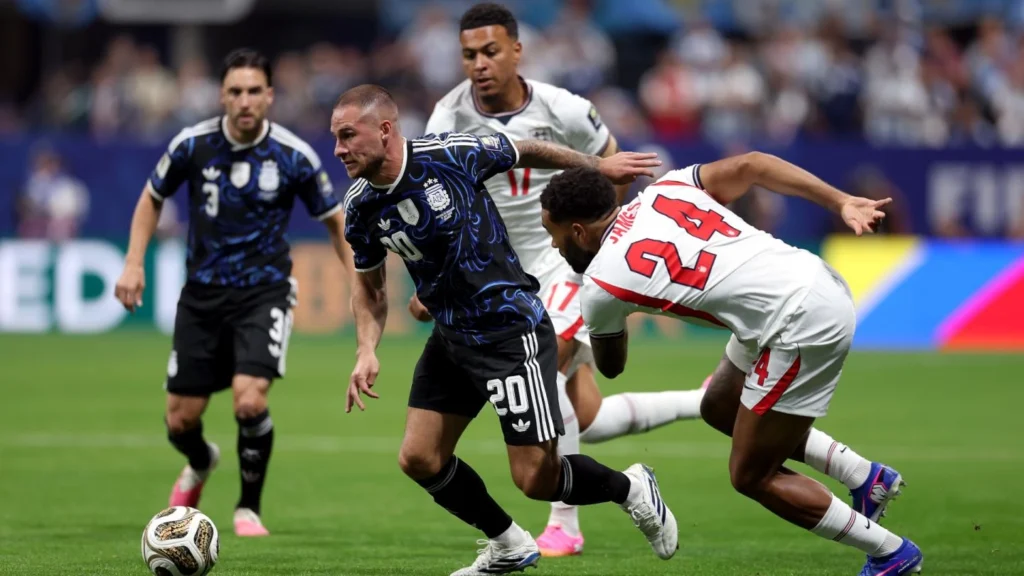
There are football teams who win World Cups. And then there are football teams who seem constitutionally incapable of losing them. Argentina, the defending champions, the holders of the trophy, the side built around the greatest player the sport has ever seen, produced yet another of their extraordinary late escapes on Wednesday night at Mercedes-Benz Stadium in Atlanta, coming from behind to beat England 2-1 in a semi-final that encapsulated everything that makes this Argentina side both infuriating to face and impossible not to admire. Enzo Fernandez struck a brilliant equaliser in the 85th minute. Lionel Messi crossed for Lautaro Martinez to nod in the winner in the second minute of stoppage time. And once again, Argentina are in the World Cup final.
For Liverpool’s Alexis Mac Allister, who played every minute of a pulsating contest that will live long in the memory of everyone who witnessed it, Wednesday night in Atlanta was another entry in a career that continues to grow in stature and significance on the biggest stages the sport offers. The Liverpool midfielder was at the heart of everything Argentina did across 90 electric minutes, combining his characteristic technical assurance with the sort of competitive intensity that a World Cup semi-final against England demands at the highest level. He came within inches of scoring the goal of the tournament at a crucial moment. In the end, his contribution across the full 90 minutes was arguably as important as any single moment on the pitch.
A Match Defined by Its Drama
Wednesday’s semi-final was the sixth meeting between Argentina and England at men’s World Cups, and it added another unforgettable chapter to one of international football’s most storied rivalries. The history between these nations at this competition carries a weight that extends beyond sport, touching on politics, geography and two nations’ complicated shared history. Referee Ismail Elfath, the first American man to officiate a World Cup semi-final, kept a firm grip on proceedings from the very first whistle, booking a player from each side before half-time as the physical edge of the contest made itself clear.
The first half was cagey, tight and tactical, both managers unwilling to offer the other an inch in a match of such magnitude. England’s Thomas Tuchel set his side up compactly, frustrating Argentina’s attempts to find the spaces between the lines that Messi and his partners crave. Argentina had the better of possession but lacked the cutting edge that has defined their knockout campaign, and the half ended goalless, the tension inside Mercedes-Benz Stadium palpable and growing.
The second half exploded into life immediately. England broke the deadlock in the 55th minute through a goal of real quality, Morgan Rogers finding Anthony Gordon with a perfectly timed pass in transition, and the Newcastle winger arrowing a finish past Emiliano Martinez with impressive composure. England were ahead and the dream was alive. For Argentina, the response needed to come from those who have delivered in moments like this before.
Mac Allister’s Agonising Contribution
For the next thirty minutes, Argentina pressed and probed, searching for the equaliser that Lionel Scaloni’s side have found so repeatedly throughout this tournament. Mac Allister was central to the increased urgency, driving from midfield, demanding the ball and moving it quickly to create the triangles of passing that destabilised England’s defensive structure. It was during this period that he came agonisingly close to becoming the man who turned the tie, his thumping header from a set-piece crashing against the inside of the post and spinning back out to safety when it appeared certain to cross the line.
The groan that followed that moment from the Argentine end of Mercedes-Benz Stadium was one of the most dramatic sounds of the entire tournament, the collective sharp intake of breath of a people whose nation’s footballing history is defined by moments of individual brilliance and tournament destiny. Mac Allister picked himself up, shook his head, and kept going. That is what Liverpool supporters have come to expect from him. That is what he does.
Then, in the final moments of the match, with England tiring and Argentina’s relentless pressure beginning to bend their defensive organisation, Fernandez collected the ball 25 yards from goal and struck one of the shots of the tournament, a bending, dipping drive that flew past Jordan Pickford before the England goalkeeper had registered what was happening. The stadium erupted. It was 1-1. Argentina were level. And those who have followed this tournament closely knew, at that precise moment, that England’s night was over.
Messi Makes the Difference, As Ever
What followed in those frantic two minutes of stoppage time was characteristic of this Argentina side and of the man who continues to define it. Lionel Messi, operating with the kind of spatial intelligence and technical mastery that defies the rational laws of what a 38-year-old body should be capable of, collected the ball on the right flank and delivered a cross of such precision that Martinez only needed to apply the faintest of touches to divert it into the net. Argentina 2-1 England. It was over.
Mac Allister’s own stoppage-time effort, a low drive from the edge of the box that struck the other post with the score level and England still in contention, had been the moment that suggested fate was leaning one way. Fernandez’s goal proved it. The final whistle confirmed it. Argentina are in the final of the 2026 World Cup, and for the second time in Mac Allister’s international career, the opportunity to be crowned world champion lies directly ahead of him.
The stats from Wednesday night tell the story of how the match unfolded. Argentina had 56% possession, registered 15 attempts on goal compared to England’s five, and created repeated chances across 90 minutes before Fernandez and Martinez finally punished England’s defensive resilience. England’s defensive organisation under pressure was excellent for long periods but ultimately, as Harry Kane acknowledged afterwards with the weary honesty of a player who has lived this story before at major tournaments, Argentina’s quality in the crucial moments proved the difference. “We’d done so well for that 60 minutes. We scored. We deserved to be ahead. And then, for one reason or another, we struggled to keep the ball, we struggled to put pressure on the ball and it just allowed them to create more momentum.” It was, as Kane himself implied, a familiar story for England at the business end of major tournaments.
For Argentina, the milestone is as staggering as it sounds. Should they win Sunday’s final against Spain, they will become only the third nation in history to successfully defend the World Cup title, joining Italy in 1938 and Brazil in 1962. They arrive at that final having been taken to extra time or the brink of elimination in each of their last four knockout games, a level of dramatic tension that has made this Argentina side one of the most compelling teams in World Cup history. Cape Verde took them to extra time. Egypt led them 2-0. Switzerland equalised with ten men in the quarter-finals. England led them with 35 minutes to play. None of it has been enough.
Mac Allister will now prepare for Sunday’s final against Spain at MetLife Stadium in New Jersey, kick-off 8pm BST, a match that will be watched by approximately 1.5 billion people across the globe. For a midfielder who began his professional career in the lower reaches of Argentine football and worked his way to Brighton, then Liverpool, then the World Cup, winning the tournament once would have been the achievement of multiple lifetimes. The chance to do it twice is something that barely belongs in the realm of belief.
Liverpool supporters watching from home know exactly what they have in Alexis Mac Allister. On Wednesday night in Atlanta, the world got another reminder.
🔴Find the Latest News on Player Ratings | Transfers | Prematch | Postmatch
Thank you for your continued support, and let’s cheer Liverpool on to success in the upcoming match. Your thoughts are always welcome in the comments section. For further insights, you may explore the official Liverpool FC website by clicking here.
YNWA (You’ll Never Walk Alone)!
The Liverpool FC Times Team
LiverpoolFCTimes.com